Food production environments impose some of the most demanding requirements on luminaires of any industrial sector. Lighting must be hygienic, shatterproof, resistant to washdown, and compliant with the food safety standards that govern the entire supply chain. As a UK manufacturer, we supply LED lighting for food production, processing, packaging, cold stores, and distribution facilities of every scale.
Recommended Products for Food Production Lighting
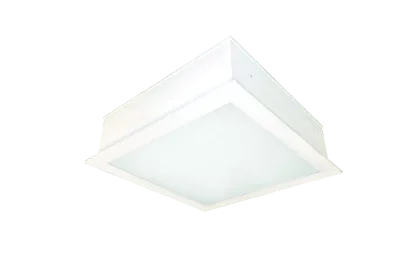
Dura
Food grade moisture resistant recessed luminaire
View Specification →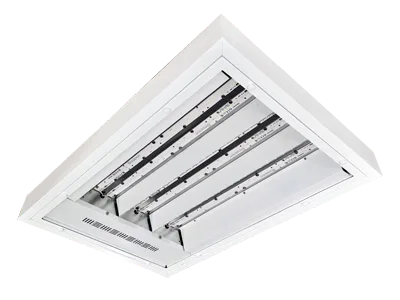
Rogue
IP65 low/ high bay luminaire, for use in hostile environments
View Specification →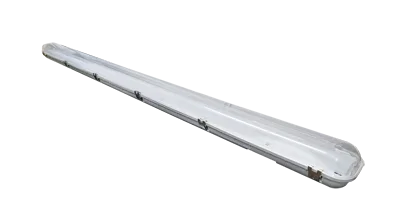
Neptune
An IP65 luminaire which is corrosion resistant and weatherproof
View Specification →Unsure which product is right for your project?
Our technical team can advise on the most suitable products for your specific space type, ceiling height and controls requirements.
Why food production lighting is a specialist category
A standard industrial luminaire is not suitable for a food production environment. In a food factory, a luminaire is a surface that must be cleaned, a potential source of contamination if it breaks, and an element of the facility that auditors will inspect against HACCP, BRC, and IFS criteria. The wrong luminaire in the wrong location can fail an audit, contaminate a product batch, or create a food safety incident forcing a recall.
The core requirements are consistent across most food production applications: luminaires must be IP65 as a minimum for general production areas, rising to IP66 for high-pressure washdown environments and IP69K for areas subject to steam cleaning or high-temperature high-pressure jets. They must be shatterproof, non-toxic, and free of glass components in areas where a breakage could contaminate food. Materials must be compatible with the cleaning chemicals and disinfectants used in the facility, and luminaire housings must have no horizontal surfaces, crevices, or joints that could trap food particles, moisture, or bacteria.
Contrac Lighting manufactures LED luminaires in-house at our East Yorkshire factory, supplying food manufacturers, processing facilities, and their M&E contractors across the UK. Our technical team can advise on product selection, IP ratings, food safety compliance, and controls integration at any stage of a project.
Contrac Lighting is ISO-certified. We manufacture luminaires at our Goole factory, with every stage from fabrication through to final tests handled in-house.
Application requirements
The table below sets out the maintained illuminance, IP ratings, and key compliance requirements for each area within a food production facility, drawn from BS EN 12464-1, SLL Lighting Guide 1, and HACCP guidance for food premises.
| AREA TYPE | LUX (EM) | MIN IP | RA |
|---|---|---|---|
| General production (low risk) | 300–500 | IP65 | 80 |
| High-risk production (ready-to-eat) | 500 | IP65 | 80 |
| Washdown areas and wet processing | 300–500 | IP66 | 80 |
| Steam cleaning zones | 300–500 | IP69K | 80 |
| Food inspection and quality control | 500–1000 | IP65 | 90 |
| Meat processing and inspection | 500 | IP65 | 90 |
| Cold stores and chill rooms | 200 | IP65 | 60 |
| Freezer stores (below 0°C) | 200 | IP66 | 60 |
| Packaging and labelling areas | 500 | IP65 | 80 |
| High-bay warehouse / dry store | 200–300 | IP65 | 60 |
| Loading bays | 300 | IP65 | 40 |
| Staff facilities and offices | 300–500 | IP44 | 80 |
Application guide
A food production facility contains a wide range of environments, each with different food safety, hygiene, and temperature requirements. What is suitable for a dry goods warehouse will not serve a wet processing area, a cold store, or a quality control inspection station.
General and high-risk production
Production areas are classified as low risk (handling raw or ambient goods) or high risk (handling ready-to-eat products). High-risk areas have more stringent hygiene requirements because a contamination incident in these zones can reach the consumer directly. In both cases, luminaires must be IP65 minimum, shatterproof, non-toxic, and free of horizontal surfaces that could harbour food debris, moisture, or bacteria. Cleanroom-style hygienic luminaires with smooth, sealed, wipe-clean housings are the appropriate product for high-risk production environments.
Food inspection and quality control
Visual inspection of food products for contamination, defects, or colour inconsistencies is one of the most lighting-sensitive tasks in a food production facility. Shadow-free illuminance at high lux levels, combined with a high CRI of Ra 90 or above, allows inspectors and camera systems to detect foreign objects, colour anomalies, and surface defects that would be missed under standard production lighting. For meat processing, poultry, and fresh produce inspection, cooler colour temperatures of 4000K to 5000K tend to improve contrast and make contamination more visible. Inspection stations may require a higher illuminance than the surrounding production area, achieved through supplementary local task lighting.
Cold stores and freezer rooms
Cold stores and freezer rooms require luminaires rated for the operating temperature of the environment: IP65 and cold-rated drivers for chill stores operating above 0°C, with components rated to at least -20°C for freezer stores below zero. LED light sources provide immediate full output at low temperatures without the warm-up delay that affects the fluorescent lamps they replace, which is a genuine operational advantage in busy cold stores where fast cycle times matter. Condensation resistance is important in environments that are accessed frequently from ambient areas, since the temperature differential causes moisture to form on luminaire surfaces.
Warehousing and dry goods storage
Dry goods warehouses within food production facilities are subject to the same HACCP and food safety standards as production areas, even though the environmental demands are less severe. IP65 as a minimum applies throughout, and luminaires should still be shatterproof and meet the hygiene requirements specified by BRC or IFS standards applicable to the site. High-bay LED luminaires with narrow beam optics are appropriate for racking aisle applications, and presence detection on an aisle-by-aisle basis delivers the most significant energy savings in areas that are occupied intermittently throughout the operating day.
Loading bays and service yards
Loading bays in food production facilities handle both incoming raw materials and outgoing finished goods, and the lighting must support safe vehicle and forklift movements as well as the visual checks that accompany goods receipt. Robust, IP65-rated luminaires are appropriate at the loading dock, with canopy-mounted fittings directing output into trailers for safe loading and unloading. Service yards and external areas should be lit to a level that supports CCTV surveillance and safe vehicle movements throughout the operating day and night. Where loading bays serve temperature-controlled facilities, the luminaires must be specified for the transition between ambient and chilled conditions.
Controls and energy management
Energy savings of 50 per cent or more are achievable in food production facilities through the right combination of controls strategies. Presence detection in warehousing, corridors, and loading areas reduces output when these spaces are unoccupied. Scene setting can be used to assign different lux levels to production and cleaning cycles, since the higher illuminance needed for thorough cleaning inspections is not required during normal production. This is a specific advantage noted by facilities managers: being able to switch to a higher-output cleaning scene at the end of a production run and return to the standard production level at the start of the next shift. Emergency lighting monitoring via central test systems reduces the manual inspection burden across large, complex sites.
Emergency lighting
Emergency lighting in food processing facilities must match the IP rating of the general lighting in each area, since the environmental demands are the same whether the lights are operating normally or on emergency power. In high-bay areas, wall or pillar-clamped emergency luminaires are often more practical than ceiling-mounted fittings, bringing the luminaire down to a maintainable height and avoiding the access difficulties of ceiling mounting above processing equipment. BS 5266-1 requires 1 lux minimum on escape route centrelines and 0.5 lux in open areas exceeding 60m². Self-test systems reduce the manual testing burden considerably on large food production sites.
Standards & compliance
Food processing lighting sits at the intersection of lighting standards and food safety regulatory frameworks. Below are the most commonly referenced standards and audit criteria across UK food production facilities.
Hazard Analysis and Critical Control Points
HACCP is the internationally recognised food safety management framework that underpins all UK food production requirements. Under a HACCP system, lighting is assessed as a potential hazard at each critical control point: a broken luminaire could introduce glass or foreign body contamination, and inadequate illuminance could cause a hygiene hazard to be missed. Luminaires in food production areas must be shatterproof, non-toxic, and hygienic in their design. The HACCP assessment should document the luminaire specification and the cleaning and maintenance procedures for each area.
BRC Global Standard for Food Safety
The BRC Global Standard is one of the most widely adopted food safety certification schemes for UK food manufacturers and processors, covering food safety, quality management, and operational controls. BRC auditors will inspect luminaire specifications, assess contamination risk from broken fittings, and verify that lighting levels are adequate for the tasks performed in each area. Luminaires must be documented as food-safe within the site's quality management system. BRC also covers food packaging manufacturers, so the standard applies more broadly than primary food production alone.
International Featured Standards: IFS Food
IFS Food is used to evaluate food processing companies across Europe and is recognised as an equivalent to BRC for many major retail buyers. IFS auditors assess lighting under the hygiene and contamination prevention requirements of the standard, examining luminaire construction, IP rating, shatterproof status, and cleanability. Companies certified to IFS Food must be able to demonstrate that their luminaire specification is consistent with the contamination control requirements documented in their HACCP system.
BS EN 12464-1: Lighting of Indoor Work Places
The primary reference standard for maintained illuminance, uniformity, glare limits, and colour rendering across all occupied areas of a food production facility. Defines 300 to 500 lux for general production areas, 500 lux for inspection and quality control tasks, and higher levels for fine visual work. Referenced alongside SLL Lighting Guide 1 for specific food, drink, and tobacco industry applications.
SLL Lighting Guide 1: The Industrial Environment
CIBSE SLL Lighting Guide 1 provides specific guidance for the food, drink, and tobacco industries, covering illuminance recommendations for production areas, inspection stations, cold stores, and ancillary spaces. Referenced by Thorlux, among others, as the primary UK guidance document for food industry lighting design. Covers both the photometric requirements and the practical considerations of luminaire selection in food environments.
BS EN 60529: Degrees of Protection (IP Code)
Defines the IP rating system used to specify luminaire protection against solid particles and liquids. For food production, the relevant ratings are IP65 (dust-tight; low-pressure water jets from all directions), IP66 (dust-tight; high-pressure water jets), and IP69K (dust-tight; high-temperature high-pressure steam and water jets at close range). Both the IP rating and the test methodology are defined in this standard, and claimed IP ratings for food-safe luminaires should be verified against the test conditions in BS EN 60529.
Bespoke Food Production Lighting Lighting Solutions
From CIBSE-compliant lighting designs to custom architectural fabrication, our Goole-based engineering team is ready to support your project requirements. Contact us for specification pricing, photometrics, and lead times.