Lighting accounts for a significant share of energy consumption in any warehouse or distribution centre, and the right solution makes a measurable difference to both operating costs and the safety of everyone working in the building. As a UK manufacturer, we supply LED lighting for high-bay warehouses, racking aisles, cold stores, loading bays, and logistics facilities of every scale.
Recommended Products for Warehouse & Logistics Lighting
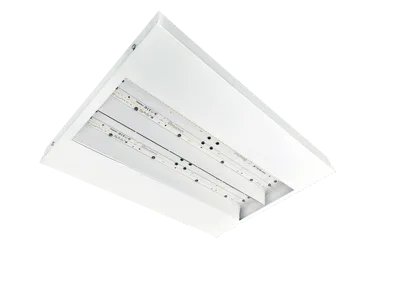
Lando
High output high or low bay luminaire
View Specification →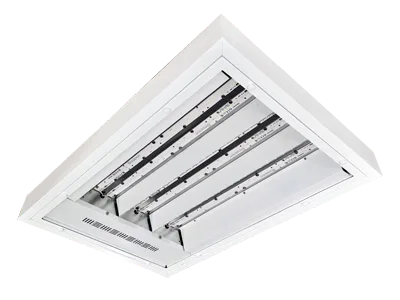
Rogue
IP65 low/ high bay luminaire, for use in hostile environments
View Specification →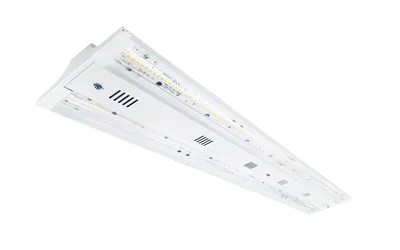
Organa
High output linear low/high bay luminaire
View Specification →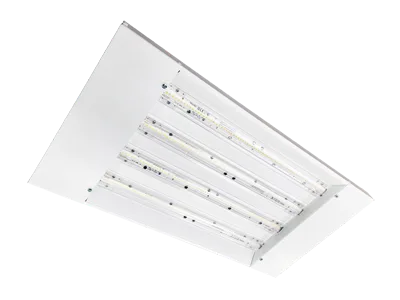
Empire
High output Industrial high bay luminaire with a choice of lens for either rack or high open areas
View Specification →Unsure which product is right for your project?
Our technical team can advise on the most suitable products for your specific space type, ceiling height and controls requirements.
Why warehouse lighting is about more than lumens
Distribution warehouses and logistics facilities are under more scrutiny than ever. Building occupiers are expected to meet increasingly ambitious ESG targets, reduce carbon emissions, demonstrate energy efficiency, and provide safe, well-lit working environments for picking, packing, and materials handling operations. Lighting is one of the few areas in a warehouse where significant, measurable energy savings can be achieved quickly.
The challenge is that warehouses are not homogeneous spaces. A high-bay racking aisle operating 24 hours a day needs a completely different approach to a temperature-controlled cold store, a loading dock, or a mezzanine picking area. Getting the luminaire type, mounting height, beam angle, and control strategy right for each zone is what separates a scheme that delivers the promised savings from one that falls short.
Contrac Lighting manufactures LED luminaires in-house at our East Yorkshire factory, supplying logistics developers, warehouse operators, and M&E contractors across the UK. Our technical team can advise on product selection, controls integration, BREEAM compliance, and energy savings modelling at any stage of a project.
Contrac Lighting is ISO-certified. We manufacture our luminaires at our Goole factory, with every stage from fabrication through to final tests handled in-house.
Application requirements
The table below sets out the maintained illuminance, uniformity, and colour rendering targets for each warehouse and logistics space type, drawn from BS EN 12464-1 and CIBSE SLL Lighting Guide 1: The Industrial Environment.
| SPACE TYPE | LUX (EM) | UGRL | U0 | RA | NOTES |
|---|---|---|---|---|---|
| General warehouse storage | 200 | 25 | 0.4 | 60 | Bulk storage with infrequent access; presence detection recommended |
| Racking aisles and high-bay | 200–300 | 25 | 0.4 | 60 | Narrow beam optics for aisle lighting; vertical illuminance on rack faces |
| Picking and packing areas | 300 | 25 | 0.4 | 60 | Consistently occupied; higher lux for detailed order fulfilment tasks |
| Mezzanine floors | 300 | 25 | 0.4 | 60 | Lower mounting height; mid-bay or surface luminaires suited |
| Cold stores (above 0°C) | 200 | 25 | 0.4 | 60 | IP65 minimum; cold-rated drivers; longer warm-up not applicable with LED |
| Cold stores (below 0°C / freezers) | 200 | 25 | 0.4 | 60 | Rated to -25°C; IP66; condensation resistance; immediate full output |
| Loading bays | 300 | 25 | 0.4 | 40 | Robust luminaires; dock lighting for trailer interiors |
| Service yards and external areas | As designed | — | — | 40 | IP65 / IP66; IK rated; CCTV-compatible lux levels |
| Office and administration | 500 | 19 | 0.6 | 80 | CIBSE LG7 standard; same as general office environment |
| Canteens and welfare areas | 200 | 22 | 0.4 | 80 | Warmer CCT; presence detection |
| Circulation and corridors | 100 | 25 | 0.4 | 40 | Presence detection; 30–40% energy saving typical |
| Car park and access roads | As designed | — | — | 40 | BS EN 13201; CCTV-compatible; uniformity for safe vehicle movement |
Space-by-space guide
A warehouse or distribution centre contains several distinct zones, each with different operating conditions, access patterns, and lighting requirements. What works in a bulk storage bay will not serve a picking area, a cold store, or a loading dock.
High-bay warehouse and racking aisles
High-bay storage areas are the largest energy consumer in a typical warehouse lighting installation, and the most significant opportunity for savings. Narrow-beam optics focus output down the aisle between racking, improving vertical illuminance on rack faces while reducing the number of luminaires required and minimising upward light waste. Presence detection on an aisle-by-aisle basis allows luminaires to dim or switch off when no forklift or pedestrian activity is detected, while maintaining an ambient level on adjacent aisles for safety. In buildings where racking configurations are likely to change, wireless-controlled systems allow zone boundaries to be reconfigured without rewiring.
Mezzanine floors and picking areas
Mezzanine floors typically operate at lower mounting heights than the main warehouse floor, which changes the luminaire type and beam angle required. Mid-bay or surface-mounted linear luminaires are generally more appropriate than high-bay fittings in these areas. Picking and packing operations involve reading small text on labels and screens, comparing product barcodes, and checking quantities — tasks that benefit from a higher lux level and better uniformity than bulk storage zones. Where conveyor systems run through picking areas, the luminaire layout should provide consistent illuminance across belt surfaces and packing tables rather than just at floor level.
Cold stores and freezer rooms
Cold store environments place demands on luminaires that most other warehouse spaces do not. In chill stores operating above 0°C, IP65 as a minimum and driver components rated for low temperatures are required. In freezer stores operating at -18°C or below, full condensation resistance is required, and components rated to at least -30°C. LED light sources provide immediate full output at low temperatures without the warm-up delay that affected fluorescent predecessors. Thermal cycling as cold store doors open and close must be accounted for in the luminaire design, and gasket integrity should be verified for the expected temperature range of the installation.
Loading bays and service yards
Loading bays are one of the most hazardous areas in a logistics building, combining vehicle movements, pedestrian traffic, and the manual handling of goods in a confined and often noisy space. Good, even illuminance at loading dock level is important for safe forklift operation inside trailers, and dock lighting. Mounted at the bay entrance to direct output into the trailer is often the most effective solution for this. Luminaires in loading bays should be robust, impact-resistant, and capable of withstanding the dust, vibration, and temperature variation that comes with direct exposure to the external environment. Service yards require lighting levels adequate for CCTV operation and safe vehicle manoeuvring throughout the site's operating hours.
Office and staff support areas
Office, administration, and welfare areas within a logistics building should be treated to the same specification as any standalone commercial environment. Office areas require 500 lux at desk height with a UGRL of 19, daylight dimming where glazing allows it, and presence detection for energy management. Canteen and breakout areas benefit from a warmer colour temperature than the warehouse floor to give staff a clear change of environment during breaks. Welfare facilities including changing rooms, toilets, and restrooms require IP44-rated luminaires in wet zones and presence detection as standard practice.
Car parks
Car park lighting directly affects staff safety at shift change times and the security of the site perimeter. It should comply with BS EN 13201 for the relevant road class, with uniformity high enough to allow safe vehicle movement and CCTV cameras to produce usable images. Presence detection can reduce energy consumption considerably during low-traffic periods while maintaining adequate levels when activity is detected.
Controls and energy management
Lighting controls deliver the largest energy savings available in a warehouse environment, and the gap between a controlled and an uncontrolled installation is substantial. Aisle-by-aisle presence detection, combined with daylight dimming in perimeter zones where roof lights or clerestory glazing admits natural light, can reduce lighting energy consumption by 50 per cent or more in real-world installations. Wireless control systems allow zones to be reconfigured as operational requirements change without the cost of rewiring, and luminaire status monitoring allows maintenance teams to identify and address faults promptly rather than waiting for the next routine inspection.
Emergency lighting
Emergency lighting in warehouse environments must account for the scale and complexity of the building, the presence of high racking that can obscure sightlines to exit signs, and the mounting height constraints that affect self-contained luminaire performance. BS 5266-1 requires a minimum of 1 lux on escape route centrelines and 0.5 lux in open areas exceeding 60m², with exit signage visible from all points along escape routes. In high-bay applications, wall-mounted or pillar-clamped emergency luminaires are often more practical than ceiling-mounted fittings and bring the luminaire down to a maintainable height. Automated self-test functions significantly reduce the manual testing burden across large sites.
Standards & compliance
Warehouse and logistics lighting specifications involve several overlapping standards. Below are the most commonly referenced across distribution centre and industrial projects in England, Scotland and Wales.
BS EN 12464-1: Lighting of Indoor Work Places
The primary reference standard for maintained illuminance, uniformity, glare limits, and colour rendering across all indoor warehouse and logistics spaces. Covers storage areas, picking and packing zones, loading bay interiors, offices, and welfare facilities. The standard is the most commonly cited compliance requirement in warehouse lighting specifications and M&E tender documents.
SLL Lighting Guide 1: The Industrial Environment
Provides supplementary guidance on lighting for industrial and logistics environments beyond the minimum criteria in BS EN 12464-1. Covers task-specific illuminance recommendations for forklift operation, manual handling, and order picking, as well as guidance on vertical illuminance in racking aisles and the impact of luminaire positioning on safety in areas with vehicle traffic.
BS 5266-1: Emergency Lighting
Governs emergency lighting across warehouse and logistics premises. High mounting heights and dense racking create specific challenges for escape route illumination and exit sign visibility in warehouse environments. The standard requires 1 lux minimum on escape route centrelines and 0.5 lux in open areas exceeding 60m², with exit signs visible from all points along the route.
BS EN 13201: Road Lighting
Applies to access roads, service yards, and car parks associated with logistics facilities. The standard defines maintained illuminance, uniformity, and glare limits for different road classifications. HGV access roads and pedestrian car parks have different requirements and should be designed as separate zones. Presence detection on external lighting is compatible with BS EN 13201 compliance when correctly integrated.
Building Regulations Part L: Conservation of Fuel and Power
Applies to new-build and substantially refurbished warehouse buildings. The 2021 revision raises efficacy requirements and mandates controls that can demonstrate demand response capability. In large-footprint warehouses, lighting is one of the most significant contributors to regulated energy consumption, making the choice of luminaire efficacy and controls strategy material to Part L compliance.
BREEAM: Building Research Establishment Environmental Assessment Method
Increasingly required by developers and occupiers of Grade A logistics space. BREEAM credits relevant to lighting include Energy (Ene 01) for low energy design, Health and Wellbeing (Hea 01) for visual comfort, and Pollution (Pol 04) for light pollution control. High-efficacy LED luminaires with appropriate controls, combined with external lighting designed to minimise upward light output, support multiple BREEAM credits simultaneously.
Bespoke Warehouse & Logistics Lighting Lighting Solutions
From CIBSE-compliant lighting designs to custom architectural fabrication, our Goole-based engineering team is ready to support your project requirements. Contact us for specification pricing, photometrics, and lead times.